

Anti Ogilvy
Loose thoughts on being a little rough and raw


It’s a pretty provocative title.
So let’s start with a tangent.
I started collecting vinyl records sometime around 2000. Back then the reason for doing so was simple.
If you wanted to get your hands on good club music you had to buy records.
CDJs had been invented but they weren’t very good yet. No club DJ trusted them to play a whole set on. Maybe just an occasional unreleased track.
Any and every proper club had Technics 1200/1210s.
There was a whole ecosystem around the production of vinyl. It was mainly based on independent labels producing limited runs of releases. 500 copies or 1000 or whatever.
If you wanted to get a new track you had to buy it on record when it came out in that run. If you missed it you you didn’t get it. Or at least not until it was repressed. And not all records were repressed.
Big and popular tracks would make it onto “Mix CDs” that would be put out by famous DJs. But by then a lot of the tracks on them had already been playing in clubs for a year or more.
In 2004 I flew to London from Sydney for the first time. Some guys I was hanging out with had one of the new models of Pioneer CDJs that would shortly come to dominate in clubs. They were bringing it to venues with them to add to the Technics turntable set up so they could play more of their own music in a reliable way.
I clearly remember being at a friends apartment when one of the guys walked in with the new CDJ. It was the first time I had seen one with my own eyes. It felt like a big deal and that change was coming.
We partied all weekend and they dragged that goddamn CDJ everywhere we went.

At the same time a revolution in the production of club music was happening. In the 1990s a computer would be part of a studio. The heavy lifting was still done by physical machines. Synths, mixers, pedals, samplers, effects and drum machines etc.
I’m talking here about home studios or small professional studios where the bulk of good club music was made.
But between 2000-2005 both the power of computers and the improvement in software allowed for computer only music to be made. A new producer no longer needed to buy all those pieces of expensive gear. A democratising revolution so to speak.
And a decent chunk of producers who did have the old gadgets also made the switch to the convenience of the computer. Lots of classic hardware was sold off at prices many people would later come to regret.
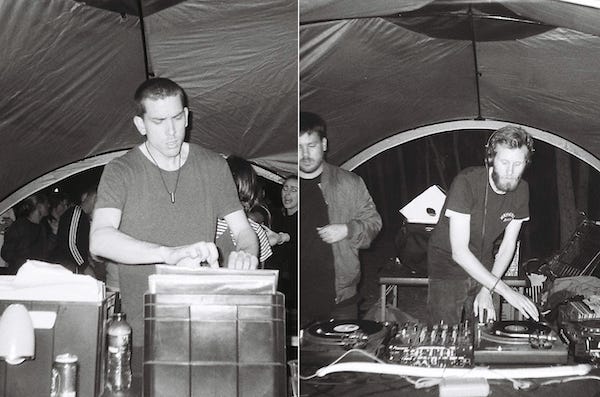
Fast forward briefly to around 2018.
I’d always be talking with other friends about records we were buying. Guys would spend hours “digging” on sites like discogs for cool old records in addition to the newer releases they were collecting.
For digging, there was a common consensus that circa 2004/05 to about 2010 was a dead zone for finding good music.
I’m not gonna claim that this was all due to the CDJ and computer revolution. But it was definitely a major factor.
And the tell is in what started happening in 2010 or a little before.
People were starting to realise there was something missing in a lot of computer only made music. Some kind of life or soul had gone.
See, a classic analog drum machine like the Roland TR-808 is alive in a recording. Each hit of the kick drum can vary slightly in volume and punch. The time and the groove may partially drift. There is noise and hiss captured by the audio cables.

And it turns out that all this imperfection is much more appealing to the human ear.
The variations, although seemingly imperceptible, better resembled life and stimulated our brains in a way the strict digital mechanics of a computer didn’t. The hiss and the noise added a depth to the sound that felt less sterile.
And so a counter revolution was born.
Vinyl production was going back up. People started to buy back their old synths (often at crazy mark ups). New companies came into the market to build and sell physical machines.
It was a good time to go out and party again.
And the revolution slowly made its way into the mainstream.
I first visited Berlin in 2005. Outside of people that were into club music or art no one understood why I went there. By the mid 2010s it was an “it” destination and a few years later the tech companies were moving in.
Then the vinyl revolution was practically broken by wealthy boomers.
They got into fancy audio gear and decided they all needed a copy of The Dark Side of the Moon. Production plants were limited and couldn’t keep up with demand. The small independent labels got pushed aside.
It’s all part of the natural progression and cycles of what’s cool and in and what’s not.
Which is probably a good cue to start to tie this up.
So, Ogilvy.
He’s great. A true pioneer.
But his writing style and advertising was designed for mass consumption. Super clean and easy to digest.
And that mass is eating itself.
See, any kid now can get access to Ogilvy’s work and imitate him.
Nearly all content and advertising sounds the same. Follows the same formulas. Doles out the same advice. Stylistically it’s indistinguishable.
AI for writing is nothing but being generic on steroids.
People are bored…
And this is a whole bunch of good news.
Dan Kelly used to advise advertisers to look at their competition and do the opposite.
The bar for writing and advertising with personality and individuality has never been lower.
Having a little hiss and imperfection in your content (that’s not faked) will resonate with those turned off by the slop.
A couple of brief NBs
Nothing I wrote above has anything to do with so called “EDM” which is amongst the most godawful and embarrassing sounding music I have ever heard.
Supposedly UGC is about as believable as reality TV and looks worse.